

The five commonly used wellhead tools --The swivel
A kawa is a tool used during the drilling process to secure and suspend the drill string in the well. The kawa is mainly composed of the kawa body, kawa teeth, handle, and connecting parts. Different-sized drill strings require different-sized kawas. 1. The classification of kawas is based on their functions: drill pipe kawa, drill collar kawa, and casing kawa. It is divided by structure into: three-piece, four-piece kawas, and long-type, short-type kawas, etc. It is categorized by operation methods into: power kawa and manual kawa. 2. The three-piece kawa
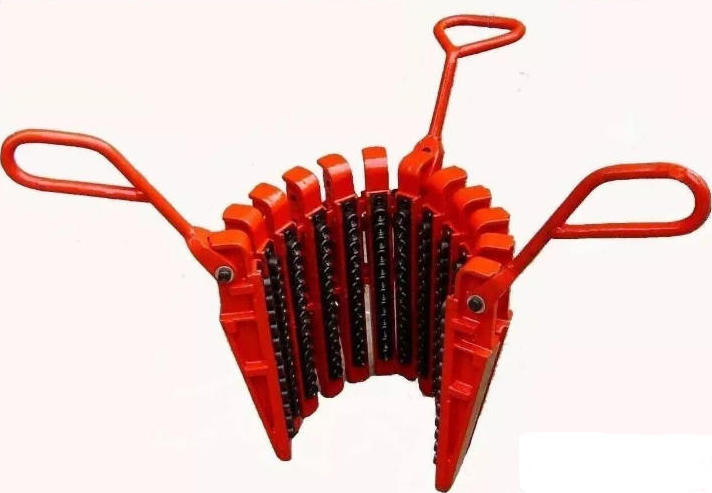
The three-piece choke is composed of three fan-shaped choke bodies, which are interconnected by hinge pins but do not close. The drill string can freely enter and exit. Each choke body has a circumferential dovetail groove and is equipped with a liner and a choke tooth. By replacing the liner and the choke tooth, the choke can be used in different drill strings within a limited range. The length specifications of the drill pipe choke (Varco) are SDS, SDML, and SDXL, with three length specifications. SDS type is a short choke, with a size range of 2-3/8" to 4 ½". SDML type is a medium choke, with a size range of 2-3/8" to 5 ½". SDXL type is a medium choke, with a size range of 3-1/2" to 5 ½". When the choke grips the drill string and rests inside the rotary table bushing, the choke teeth closely fit the drill string, and the drill string is held in place. When the choke is lifted, because the teeth pin of the choke is slightly upwardly inclined, the surface of the choke teeth can easily disengage from the drill string, and by lifting the choke, the drill string can be raised and lowered. This form is used for 2-1/2" and 4-1/2" choke and 5" and 7" choke. When the choke is required to bear a large load, a large-angle three-piece choke can be used. Its structural features are that the angle of surrounding the drill string is large, and the choke tooth body is lengthened. This can provide a greater grip on the drill string, a longer grip length, and can withstand a larger load, suitable for deep wells. Since the choke teeth are not continuously installed in the choke body, when tightening the drill string, there will be no slipping. The disadvantage of this choke is that due to the large size of the choke teeth, when they break during operation, they are prone to fall into the well. Therefore, when manufacturing this choke, better materials and higher manufacturing techniques must be adopted to improve the resistance to cracking. 3. Multi-piece Choke (Casing Choke) This multi-piece choke is generally used on large-diameter loads. Each choke body is interconnected by connecting pins, but does not close. Each choke body has a circumferential dovetail groove, and each groove is equipped with a single integral choke tooth. There are a total of eleven pieces.
4. Drill Spool Clamp The Varco drill spool clamp models are: DCS-S, DCS-R, and DCS-L. The size ranges are as follows: DCS-S: 3" to 4", 4" to 4-7/8"; DCS-R: 4½" to 6", 5-1/2" to 7"; DCS-L: 6-3/4" to 14".
5. Safety Clamp The safety clamp is used when lowering or raising drill collars, core barrels, and large-diameter pipes to prevent the drill tools from entering the well. It is composed of several sections of clamp bodies connected together through pin holes, and the two ends are connected to the screw rod through chain plug pins to form a variable clamp. Changing the number of tooth plates of the safety clamp can adapt to different sizes of drill collars and pipe strings. For drill collars without shoulders, a safety clamp should be used. The safety clamp consists of a tooth plate sleeve, clamp teeth, spring, adjusting screw, nut, handle, and connecting rod. When using the safety clamp, tighten the nut, then gently strike each pin with a hammer to ensure that the clamp teeth fully contact the drill collar in the circumferential direction, thereby providing safety protection. The distance between the safety clamp and the clamp teeth is 5 cm.
6. Pre-use Inspection 1) When the clamp teeth are worn down to 1/4 of their original height, new tooth plates should be replaced; 2) If the new tooth plate is installed in the tooth plate slot and shakes, the clamp body is scrapped; 3) The hinge parts should be flexible and complete. If there is wear, replace the components in time; 4) When opening the clamp, the opening should be no less than the nominal size of the drill tool; 5) At least 80% of the teeth of the new tooth plate should be in contact with the drill body after installing the new tooth plate.
7. Precautions 1) Select the appropriate clamp size according to the drill tools in the well. 2) Check the sharpness of the clamp teeth, ensure they are not loose, not installed in the wrong position, and whether they are clean. Check if the screws, opening pins, and nuts are complete and tightened, and if the connecting shaft pins can rotate flexibly. 3) After 1000 meters of well depth, it is mandatory to use double hanger clamps for raising and lowering drill collars. Do not use the clamp with the safety clamp for raising and lowering drill collars (on land). 4) When raising or lowering drill collars, the clamp should be used together with the safety clamp. The distance between the clamp and the mother bolt end face is 50 cm, and the distance between the safety clamp and the clamp is 5 cm. 5) After raising or lowering the drill collars, at least 80% of the teeth of the safety clamp should be in contact with the drill body; 6) Do not overload during use, do not use incompatible models. 7) Avoid raising the pipe string too quickly during use, which may cause the clamp teeth to fracture or leave deep scratches on the surface of the pipe string. Do not throw the safety clamp when the hanger is overloaded or when the pipe is rapidly lowered to cause impact. 8) After use, clean the clamp, keep the inclined surface of the clamp clean, and lubricate it frequently. Apply anti-rust oil to the exposed surface and store it in a well-ventilated and dry place indoors. 9) The clamp teeth should be placed in sets according to the specified quantity and not reduced arbitrarily. 10) Replace the worn parts in time. 11) During field operations, keep all components clean.
8. Maintenance and Care (1) Do not use the drill pipe clamp as a drill collar clamp. (2) Before use, check if all rotating parts are flexible and if there is any jamming phenomenon. (3) Before use, check if the conical surface and clamp teeth of the clamp body have plastic deformation and excessive wear. If so, replace them in time. If the clamp teeth are clogged with dirt, clean them. (4) Do not overload during use, do not use incompatible models. (5) Avoid raising the pipe string too quickly during use, which may cause the clamp teeth to fracture or leave deep scratches on the surface of the pipe string. Do not throw the safety clamp when the hanger is overloaded or when the pipe is rapidly lowered to cause impact. (6) After use, clean the clamp, keep the inclined surface of the clamp clean, and lubricate it frequently. Apply anti-rust oil to the exposed surface and store it in a well-ventilated and dry place indoors. (7) Place the clamp teeth in sets according to the specified quantity and do not reduce them arbitrarily. (8) Replace the worn parts in time. (9) During field operations, keep all components clean.